Mission Control wins a contract of up to $2M from the Canadian Space Agency to Develop Autonomous Science Instrument for Lunar Rover
Mission Control’s iSPI+ instrument will bring AI-powered, thermal-infrared science to
the Canadian Lunar Utility Rover and advance Canada’s search for lunar water ice.
Mission Control is proud to announce they have been awarded a contract worth up to $2 million by the Canadian Space Agency (CSA) to develop an advanced autonomous science instrument for the Canadian Lunar Utility Rover. The initial award of $800,000 to conduct a Phase 0 study will kickstart development of Mission Control’s next-generation instrument, iSPI+ (Intelligent Sensing and Perception in Infrared: Parallelizing Lunar Utility and Science) which combines advanced thermal-infrared sensing with autonomous decision-making to support lunar science and rover operations iSPI+ is designed to transform how science is conducted on the lunar surface. Rather than depending on constant human oversight, iSPI+ uses onboard autonomy to:
- Identify scientifically relevant features on the lunar surface
- Prioritize high-value targets
- Task data collection in near real time
This approach enables low-latency science operations while dramatically reducing bandwidth
requirements and minimizing the workload for Earth-based science teams. These efficiencies are
essential for the Lunar Utility Rover, which must balance science activities with a range of
operational tasks.
To deliver iSPI+, Mission Control is partnering with a cross-Canada team of experts—including INO, Nunabox, University of Alberta, York University, Western University, Sherbrooke University, the University of Winnipeg, Concordia University, and Polytechnique
Montréal—that brings together world-class strengths in planetary science, infrared sensing,
thermal imaging, AI, and space robotics.
““iSPI+ will revolutionize our understanding of the fine-scale temperature structure of the lunar surface. This will allow us to identify features like “micro cold traps,” small pockets of low temperatures that could host water ice and other volatiles. Current orbital instruments do not have sufficient resolution to locate these important reservoirs.” Said Dr. Catherine Neish, an Associate Professor in the Department of Earth Sciences at Western University.
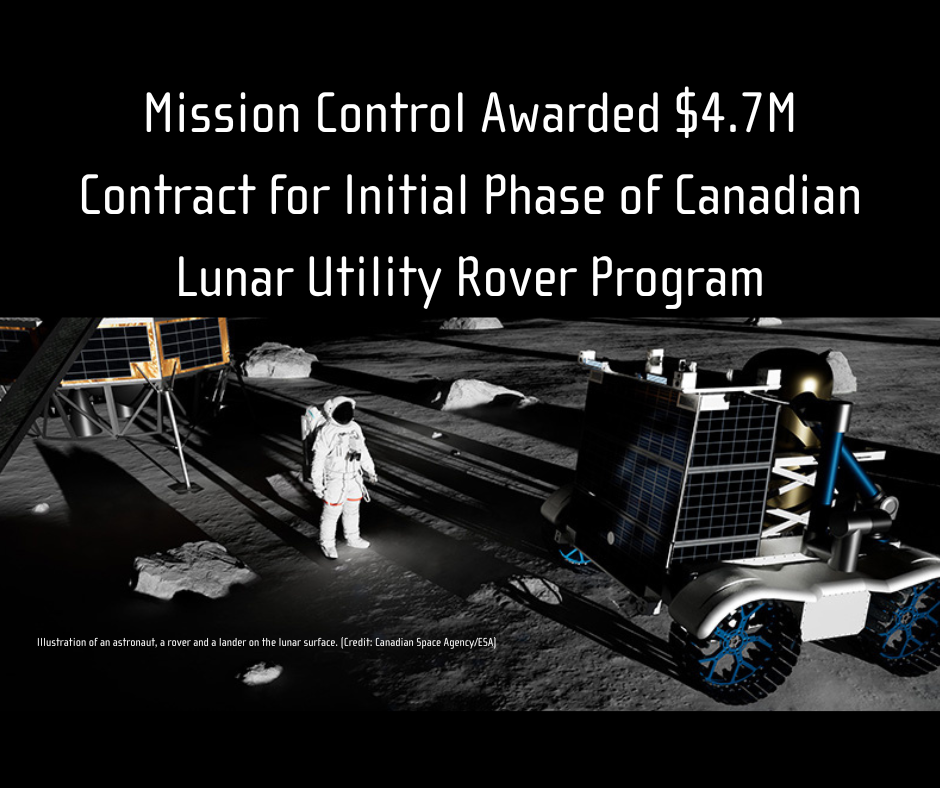
This milestone follows Mission Control’s recent selection as one of only three companies chosen by CSA to design the Canadian Lunar Utility Rover itself, underscoring the company’s leadership in autonomous robotics and intelligent planetary exploration technologies.
“Being selected for both the rover development and this science instrument contract reflects the hard work, technical progress, and dedication of our entire team,” said Dr. Tanya Harrison, Mission Control’s Director of Earth and Space Science. “We’ve invested years into advancing autonomous space technologies, and iSPI+ is a direct result of that commitment.” Mission Control continues to advance the state of the art in AI-driven autonomy, mission software, and planetary robotics— supporting Canada’s leadership in future lunar missions.
Read the official news release from the Canadian Space Agency here